
Two Safety Strategies, Not One Winner
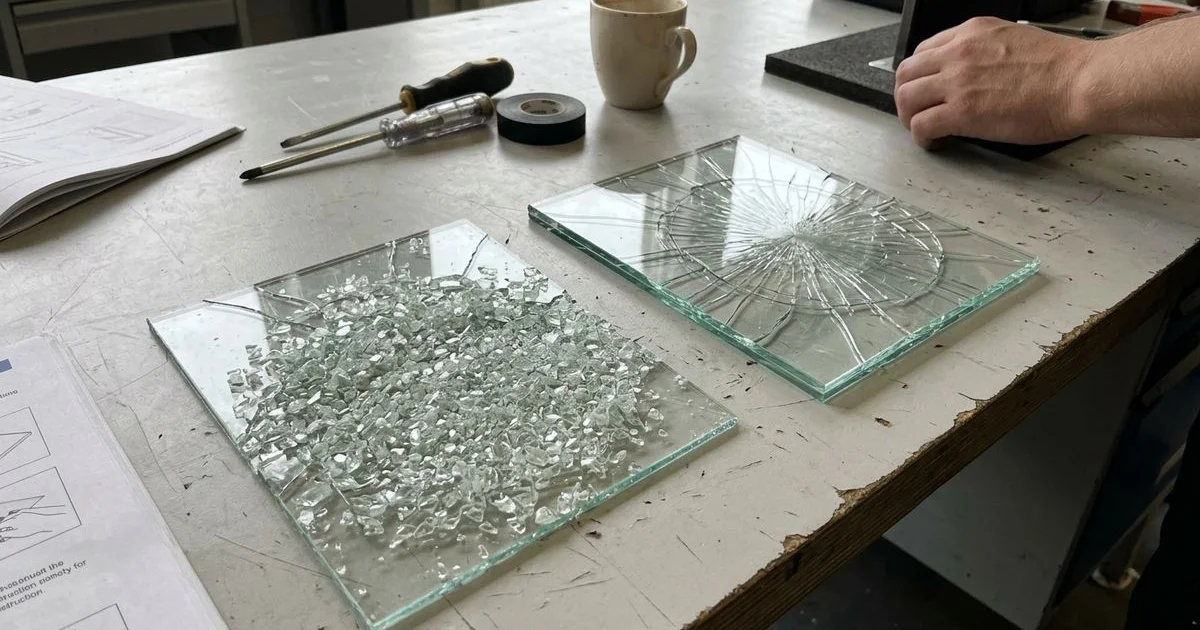
Tempered and laminated glass are both safety glass, but they pursue safety by opposite strategies. Tempered glass resists breaking, and when it finally does, it disintegrates into blunt granules. Laminated glass accepts that it may crack, and holds every fragment in place on a plastic interlayer so the panel stays standing.
Which strategy is “safer” depends entirely on where the glass lives — on tempered glass doors, balustrades or canopies — which is why this decision belongs to the application, not the brochure.
How Each One Fails
Tempered glass is heat-treated to lock its surfaces in compression — our guide on what tempered glass is and how it is made walks the process — making it up to five times stronger than annealed glass. When broken, the whole panel crumbles at once into small granules that fall clear — safe at floor level, but leaving an open frame where the panel stood.
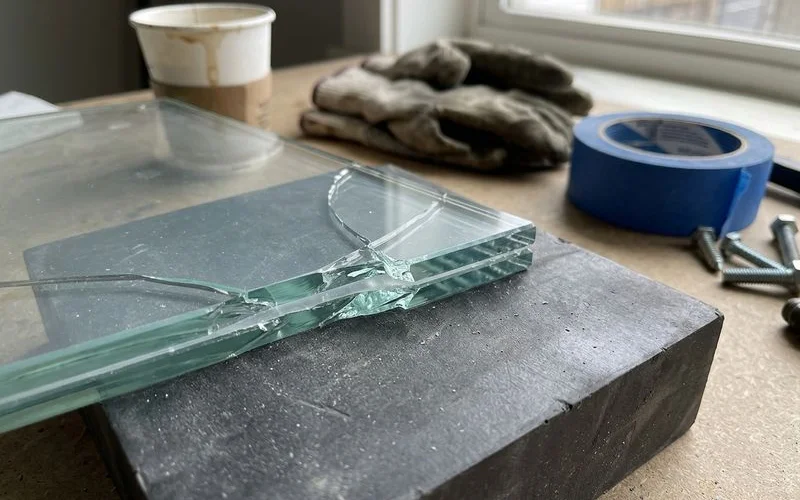
Laminated glass bonds two glass layers around a tough PVB (polyvinyl butyral) interlayer. Impact may crack the glass, but the shards stay glued to the interlayer, spiderwebbed yet intact. The barrier keeps doing its job until the panel is replaced.
Matching Glass to Application
| Application | Best choice | Why |
|---|---|---|
| Entrance and interior doors | Tempered | Impact strength for daily use; granules safe at floor level |
| Shopfronts | Tempered (laminated for security) | Strength first; interlayer resists break-ins where needed |
| Balcony railings over drops | Laminated / laminated-tempered | Barrier must remain after breakage |
| Overhead and canopy glazing | Laminated | Fragments must not rain down |
| Shower screens | Tempered | Wet-area impact safety, granule break |
The question that decides it
If this panel breaks, is it acceptable for the opening to be empty? At a door, yes — you sweep up and board over. On a tenth-floor balustrade or a canopy over a walkway, absolutely not. “No” means laminated.
Doors are tempered territory, which is why tempered glass doors are the industry standard: entrance leaves take constant impact, and a granule failure at floor level endangers nobody. Balustrades over drops flip the logic — our guide on balcony railing safety covers why fall-protection glazing favours the interlayer.
The Best of Both: Laminated-Tempered
Where a project needs tempered strength and post-breakage retention — glass floors, demanding balustrades, high-security shopfronts — the two technologies combine. Laminated-tempered glass bonds two toughened panels around a PVB interlayer: harder to break than laminated annealed, and held in place if it ever does.
All of it — tempered to MS 1498, laminated, or the combination — is within our fabrication scope. Tell us where the glass is going, and we will specify the construction honestly for the risk it actually faces, with an exact quote after the RM50 measurement visit.