
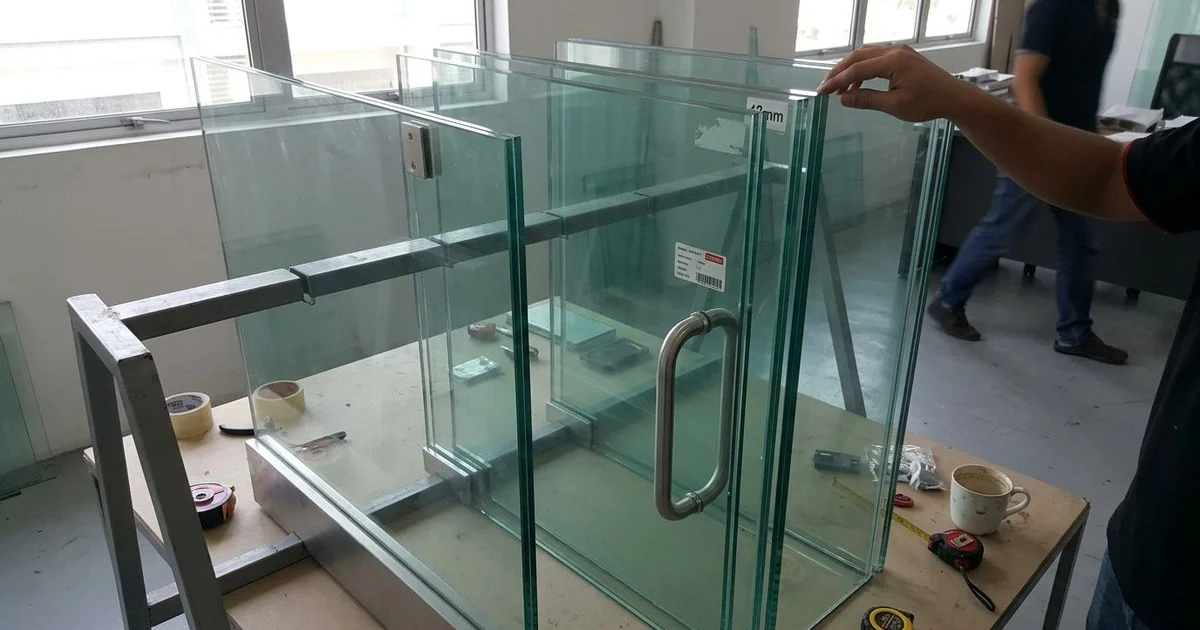
Three Thicknesses, Three Jobs
Nearly every tempered glass door we fabricate is 10mm, 12mm or 15mm, and each thickness has a natural territory. The panel must be stiff enough not to flex in use, heavy enough to feel solid, and light enough that its hardware survives — thickness is how those three demands get balanced.

| Thickness | Typical applications | Character |
|---|---|---|
| 10mm | Interior doors, office partitions, shower doors | Lighter, economical, easy on hardware |
| 12mm | Shopfronts, main doors, most commercial entrances | The all-round workhorse |
| 15mm | Large main entrances, tall leaves, prestige frontages | Maximum stiffness and presence |
10mm suits interior and lighter-duty doors: office partition doors, meeting rooms, residential room dividers and most shower applications. It keeps weight down, which keeps hinge and spring costs down with it.
12mm is the default answer for shopfronts and commercial entrance doors. It carries the daily abuse of public use, spans standard leaf sizes without noticeable flex, and pairs with widely available floor springs and patch fittings.
15mm earns its place on large or tall leaves where a thinner panel would flex, and on prestige entrances where the deeper, more solid feel of the heavier panel is part of the design.
Weight: The Consequence Buyers Forget
Every step up in thickness adds real weight — glass runs about 2.5kg per square metre per millimetre of thickness, so a 2.1m × 0.9m leaf weighs roughly 47kg at 10mm, 57kg at 12mm and 71kg at 15mm.
That weight lands on the hardware. Floor springs, pivot hinges, clamps and patch fittings all carry load ratings, and a spring sized for 10mm glass will leak and fail early under a 15mm leaf. Our door hardware range lists the load rating against every floor spring, hinge and clamp, so the fitting can be matched to the leaf rather than guessed; for automatic doors, leaf weight also sets the motor spec, which is why our sliding systems carry a 200kg per-leaf rating.
Thicker is not automatically better
Oversizing wastes money twice: once on the glass, again on the heavier hardware it forces. The right thickness is the one matched to the leaf size and duty — not the biggest number on the list.
Getting the Number Right for Your Door
In practice, thickness selection takes minutes once the leaf dimensions and use are known: interior versus entrance, leaf height and width, framed or frameless, manual or automatic. All our panels are tempered to MS 1498 regardless of thickness — see the tempered glass door range for what that certification covers — so safety is constant across the range, and the choice is purely structural and economic.
Send us your opening size and intended use on WhatsApp, and we will recommend the thickness and quote glass, hardware and installation together — measured exactly on-site for RM50, fully deductible on your order.