

First, the Two-Minute Checks
A door that will not open feels like a disaster at 9am with customers outside. Before anyone opens a toolbox — or you book an automatic door repair visit — three checks solve a meaningful share of cases, and they are all safe to do yourself.
Check power. Is the door’s isolator switch on? Has a breaker tripped? A dead controller shows no lights at all. If a power cut is in progress, note whether the door has a backup battery; without one, no power means no motion.
Check the track. Look along the floor guide for stones, packaging debris, a wedged mat corner or accumulated grit. A leaf blocked physically will refuse to move or stall part-way. Clear anything you find.
Check the sensor. Is the lens above the door filthy, taped over, or knocked askew? Wave directly beneath it. If the door is powered but ignores movement, the fault is likely in the detection chain — our sensor faults guide digs into that path.
Also worth a glance: the mode switch. Doors get accidentally set to “locked” or “exit only” more often than anyone admits.
What the Symptoms Mean
| Symptom | Likely cause |
|---|---|
| Completely dead, no lights | Power supply or controller |
| Powered but ignores people | Activation sensor fault |
| Tries to move, stalls or judders | Track obstruction, worn rollers, belt |
| Motor hums, door doesn’t move | Snapped or slipped belt |
| Opens sometimes, randomly | Sensor alignment or controller fault |
When to stop and call
If the leaf moves unpredictably, grinds, or the header smells hot — stop testing. A powered door under fault can move with force. Isolate the power and get a technician in.
Where the Professional Repair Goes
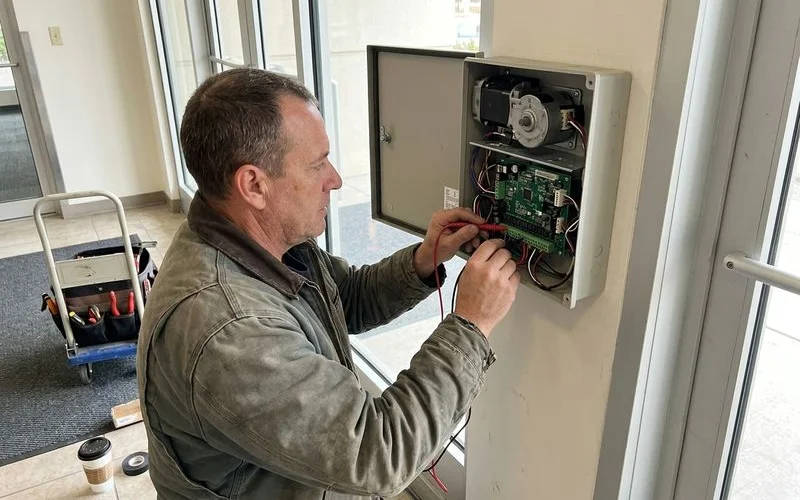
Past the simple checks, the fault usually lives in one of four places: the sensor and its wiring, the microprocessor controller, the tooth belt, or the motor itself. Our repair visits carry the common wear parts — belts, rollers, sensors, backup batteries — so most faults are diagnosed and fixed in a single visit, on any brand of door.
The pattern behind most “sudden” failures is worth knowing: they are rarely sudden. Dragging leaves, new noises and occasional missed openings are the weeks of warning a door gives before it stops. A serviced door — checked every 6 to 12 months — almost never strands you shut.
If your door is stuck right now: isolate power if anything seems unsafe, use another entrance, and WhatsApp us a video with your location. Fast, localized response across the Klang Valley is the core of what we do.