
The Five Parts That Move Every Automatic Door
Every automatic sliding door — from a clinic entrance to a mall lobby — works through the same chain of five components. If you are comparing quotes or trying to understand a fault, knowing this chain puts you ahead of most buyers.
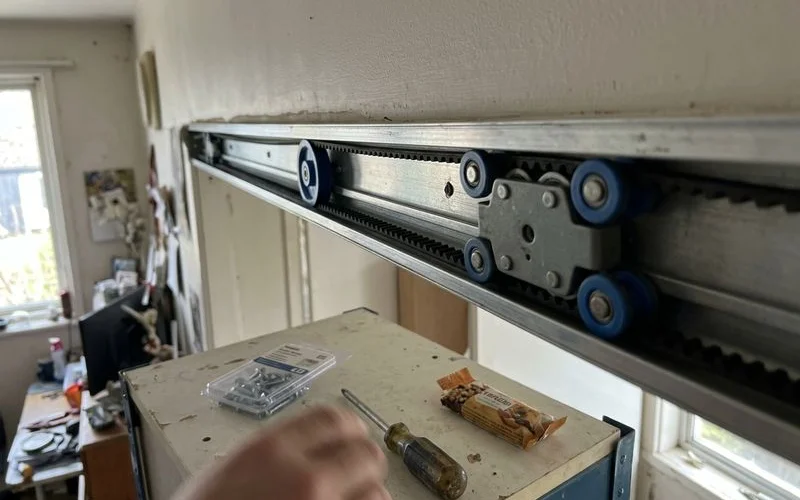
The sequence runs: sensor, controller, motor, belt, track. A microwave motion sensor above the door detects an approaching person and signals the microprocessor controller. The controller powers the motor, the motor turns a toothed drive belt, and the belt pulls the door leaves along a guide rail. Each leaf hangs from the rail on a roller carriage attached by hanger brackets, so the glass never bears weight on the floor.
On our automatic sliding doors, the drive is the HH150 worm-gear mechanism paired with a 100W BLDC motor rated to 200kg per leaf. Worm gears matter because they transmit high torque without backlash — the mechanical slack that makes cheaper doors clunk at the start and end of every cycle.
Why BLDC motors dominate quality doors
Brushless DC motors have no carbon brushes to wear out, run cooler under continuous use, and hold consistent torque across millions of cycles. On a door opening a thousand times a day, that difference decides whether the motor lasts three years or fifteen.
What Happens in the Half-Second After Detection
When the sensor fires, the controller does more than switch the motor on. It accelerates the leaves smoothly to full speed, decelerates them before the fully-open position, and holds them open while the infrared safety beam detects anyone standing in the threshold.
Closing is the reverse, with one addition: anti-clamp monitoring. If a leaf meets resistance — a trolley, a slow walker, a child — the controller senses the load spike and reverses instantly. This behaviour is central to modern powered-door safety practice, reflected in standards like EN 16005, and it is why a properly specified door never pushes against a person.
Power failure is handled by a backup battery pack in the header. Depending on configuration, it either keeps the door cycling for a period or drives it to a safe open position and holds it there.
Why Track and Roller Quality Decide Longevity
The glamorous parts are the motor and sensors, but most real-world faults start at the rollers and track. Each leaf’s full weight rides on small wheels; once their bearings wear, the leaf drops, drags and loads the motor far beyond its design point. Our systems run three wheels on two tracks per leaf — the Stable principle in our 4S engineering — precisely to spread that load and keep leaves square for years.
The protective side of the system — anti-clamp reversal, presence-sensor coverage and battery backup — is specified on every system we supply. See what that means in practice on our automatic sliding doors page.
Understanding the mechanism also makes quotations easier to compare: ask what motor, what drive type and what per-leaf rating you are being offered, and the differences between systems stop being invisible. When you are ready for numbers on your own entrance, we measure on-site for RM50, fully deductible on order.