
The Invisible Machine Under the Glass Door
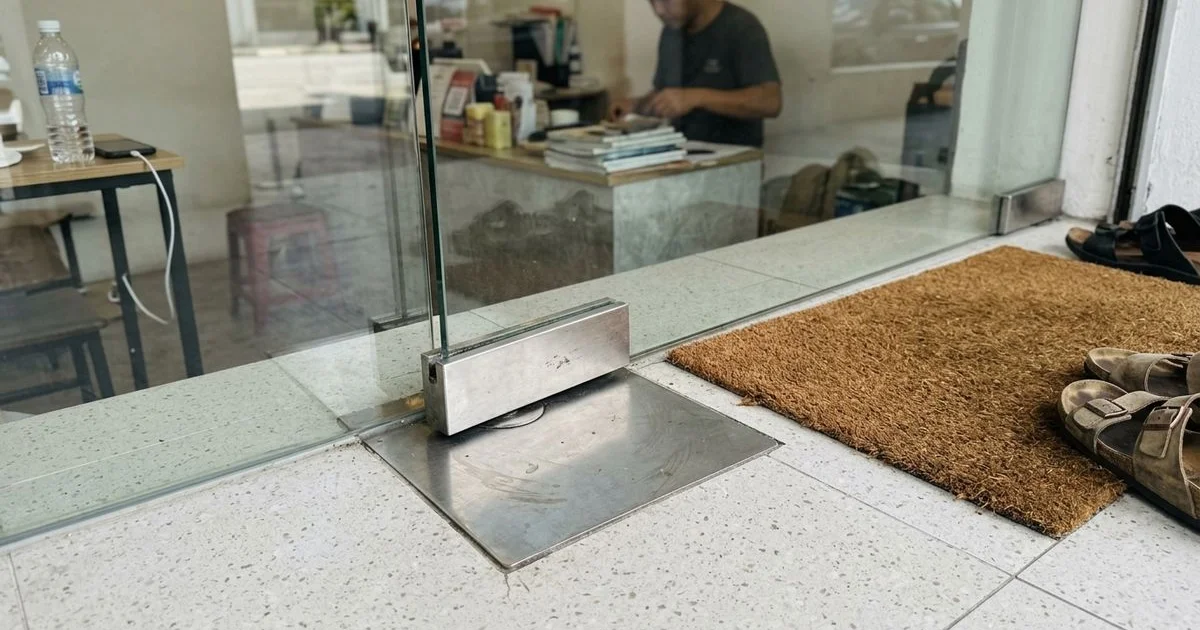
Every frameless glass door that swings open and glides calmly shut is being managed by something you cannot see: a floor spring, set into a pocket in the floor directly beneath the pivot. It is a hydraulic hinge — part spring, part shock absorber — and it does two jobs at once: it carries the door’s pivot, and it controls every degree of the door’s movement.
Floor springs are the quiet workhorses of our door hardware catalogue, and understanding them explains most of the behaviour — good and bad — of heavy glass doors.
Inside the Box: Spring Plus Oil
The mechanism pairs two elements. A spring stores energy as the door opens and releases it to swing the door closed. Alone, that spring would slam the door hard — so a hydraulic damping system forces oil through small valves as the door moves, converting the spring’s violence into a slow, controlled close.
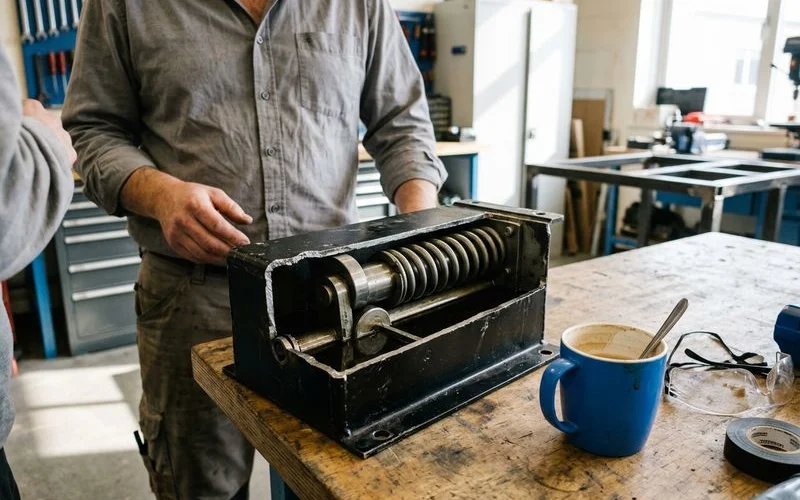
Adjustment valves tune the behaviour: closing speed governs the main swing, and latching speed gives the final few degrees a firmer push so the door seats fully closed. Many units add a hold-open point at 90 degrees and backcheck cushioning against doors flung open hard. The door connects to the unit through the pivot and — on frameless glass — through patch fittings clamping the panel’s corner; our guide on glass door clamps, patch fittings and spider fittings explains that hardware family.
The oil is everything
All the control lives in the hydraulic fluid. When the unit’s seal fails and oil leaks away, the spring keeps its full force but loses its brakes — which is why a failing floor spring announces itself as a door that slams.
Where Floor Springs Are Used — and Why Not a Closer?
Frameless glass shopfronts, office entrances and heavy timber or metal pivot doors are floor spring territory. An overhead door closer needs a frame to mount on and an arm on show; a floor spring hides its machinery underfloor, leaving nothing on the glass but a slim patch fitting. It also carries the pivot load directly, which suits the weight of 10-15mm tempered leaves far better than hinge-hung closers.
Weight rating matters: units are graded for door mass and width, and an under-rated spring wears out fast under a heavy leaf. That matching is part of every glass door we supply.
When a floor spring does fail, the symptoms are unmistakable — our guide on floor spring problems covers the slamming-door diagnosis. And if you just need the part, we supply and install floor springs across the Klang Valley, matched to your door and with free local shipping.