
Three Ways to Hold a Sheet of Glass
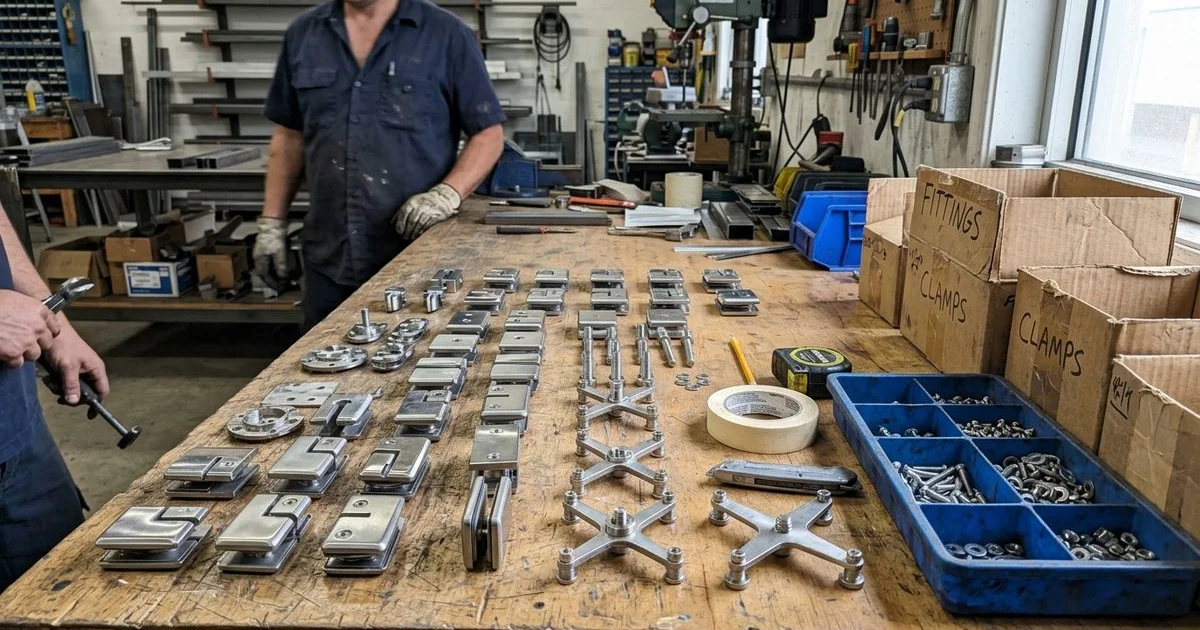
Frameless glass looks like it floats, but every panel is held by engineered metal at exactly calculated points. Three families of hardware do that work, and they are not interchangeable: clamps grip fixed panels, patch fittings operate doors, and spider fittings hang facades. All three live in our door hardware and accessories catalogue.
Knowing which is which turns a confusing hardware quote into a readable one.
Clamps: The Grip for Fixed Glass
Glass clamps are the simplest of the three — stainless steel jaws lined with rubber gaskets that grip a panel edge without drilling. Glass-to-glass clamps join neighbouring panels; glass-to-wall clamps tie a panel back to structure. You will find them on railings, shower screens, partitions and shopfront sidelights.
Their limit is load and movement: clamps hold panels that stand still. Anything that swings needs the next family.
Patch Fittings: The Door Makers
A patch fitting is the squared metal shoe you see at the top and bottom corners of every frameless glass door. It clamps the tempered panel through a drilled corner and carries the working parts: the pivot pins that connect to the floor spring below (see our guide on what a floor spring is and how it works) and the top pivot above, plus lock patches where a keyed corner lock is needed.
Patches are what turn a plain sheet of tempered glass into a functioning pivot door — and they must be rated for the panel’s weight, since a 12mm or 15mm leaf concentrates serious mass onto those two corners.
Spider Fittings: The Facade Hangers
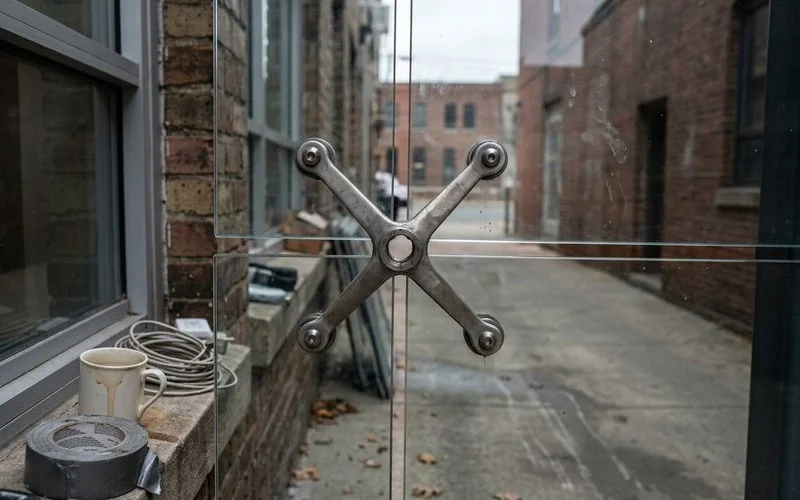
Spider fittings are the multi-arm stainless connectors of glass curtain walls. Each arm ends in a bolt that passes through a drilled, countersunk point in the glass; the spider’s body fixes back to the building structure. One four-arm spider can carry the meeting corners of four large panels, which is how whole building faces achieve glass with almost no visible frame.
Spiders handle the heaviest structural duty of the three — wind load across large facades — and their bolt points are engineered into the glass at fabrication, before tempering.
The rule of thumb
Fixed and modest: clamps. Swinging: patch fittings plus a floor spring. Large and structural: spiders. If a quote uses the wrong family for the job, question it.
We stock all three families with the gaskets, bolts and load ratings to match your glass, supply them individually to strata, retail and homeowners, and install them on our own projects daily. Send a photo of the fitting you need replaced — identification is usually instant.