

Two Good Doors, Two Different Briefs
This comparison only feels close on paper. In practice, maglev sliding doors and conventional automatic sliding doors serve different briefs, and your building usually picks for you. Maglev is the interior refinement play: silence, minimal headers, near-zero wear. Conventional belt-driven systems are the workhorses: heavy leaves, high traffic, sensors, batteries and proven serviceability.
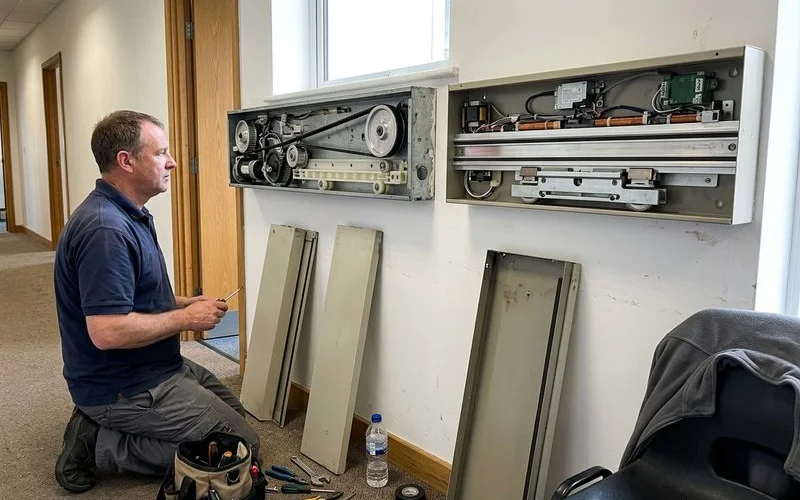
Head to Head
| Factor | Maglev | Conventional (belt-driven) |
|---|---|---|
| Noise | Near-silent, contactless | Quiet when maintained, never silent |
| Wear parts | Effectively none in the drive path | Rollers, belt, bearings |
| Maintenance | Cleaning and alignment checks | Scheduled servicing every 6-12 months |
| Leaf capacity | Interior-scale leaves | Up to 200kg per leaf (100W BLDC) |
| Traffic rating | Residential and light commercial | Continuous-duty commercial |
| Cost | Premium, quoted per project | From RM2,000 |
Noise is maglev’s headline win. Levitation removes roller contact, the main sound source of any slider — our guide on what a maglev sliding door is explains the contactless drive behind that. In bedrooms, hotel suites and studios the difference is obvious, especially at night.
Maintenance and longevity split the honours. Maglev’s drive path has nothing to wear, so it wins on parts. Conventional doors wear rollers and belts — but those parts are inexpensive, stocked, and swapped in a single service visit, which is why well-maintained conventional systems still deliver 15 to 20 year lives.
Capability belongs to conventional. Heavy tempered leaves, continuous public traffic, anti-clamp safety packages, backup batteries and breakout options are conventional-system territory. Maglev is not built to shift a 200kg security-glass leaf all day.
The one-question shortcut
Is this door for people who live or stay there, or for the public passing through? Living spaces lean maglev. Public throughput leans conventional.
Where the Premium Is Justified
Maglev’s cost premium pays for itself in spaces where its qualities are actually experienced: a master bedroom divider used twenty times a day by people who value quiet, a suite door in a boutique hotel, a studio partition behind a reception desk. In those settings the silence and the clean header are the product.
At a shopfront doing two thousand cycles a day, the premium buys nothing the visitor notices — and gives up the heavy-duty motor, safety sensors and quick-service parts the entrance genuinely needs.
If you are unsure which side of the line your project sits on, send us the opening dimensions and intended use. We quote maglev per project and conventional from RM2,000, and the RM50 on-site measurement — deductible on order — settles the specification either way.