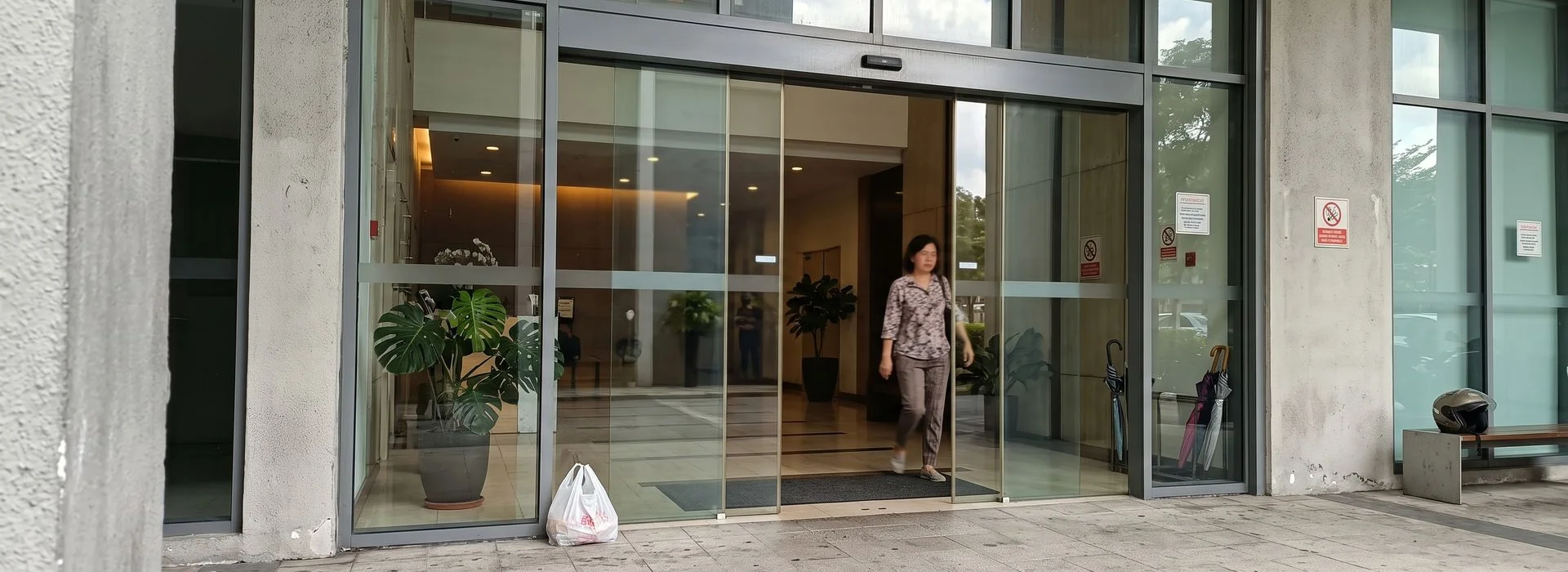

Some entrances fail loudly. This one had been failing quietly for months — a twin-leaf automatic slider at a busy Klang Valley commercial premises that dragged a little more each week, ignored its sensor a few times a day, and finally started trapping itself half-open during peak hours.
The owner’s facilities team had patched it twice with generic parts. By the time they messaged us, the question was no longer whether to repair or replace. It was how to replace a mission-critical entrance without shutting the front door on a working business.
The Starting Point: A Door Past Saving
Our first visit was a diagnosis, not a sales call. The findings were blunt:
- Roller bearings were flattened, dropping the leaves onto the guide track
- The track itself was worn through its anodised layer and gouging
- The brushed DC motor was overheating under the extra drag
- The activation sensor had been misaligned by a previous patch job
- No backup battery — a power cut meant a stuck door

Individually, each fault was repairable. Together, on a door doing thousands of cycles a day, repair was money thrown after a system that would fail again within the year. We recommended replacement with our heavy-duty automatic sliding system and put the numbers in writing.
Repair or replace?
Our rule of thumb: when three or more core components — motor, rollers, track, controller — are worn at once on a high-traffic door, replacement usually beats the accumulating cost of piecemeal repairs.
The Specification: 4S From the Ground Up
The replacement was specified to our 4S Principles, sized for the entrance’s traffic and the weight of its new tempered glass leaves.
| Component | Specification |
|---|---|
| Mechanism | HH150 worm-gear drive |
| Motor | 100W BLDC, 200kg per leaf, continuous duty |
| Stability | 3 wheels running on 2 tracks per leaf |
| Safety | Anti-clamp reversal + infrared presence beam |
| Power failure | Backup battery pack, opens to safe position |
| Activation | Microwave motion sensor, both directions |
The worm-gear mechanism was the quiet hero of the spec. Worm gears transmit high torque without backlash, which is what keeps a heavy door silent at full speed — no rattle on start, no clunk on close.
The Installation: One Working Day
Because the premises could not close, we sequenced the work for a single day. The old leaves came off first thing in the morning and a temporary barrier kept the side entrance flowing. The new guide rail and HH150 header went up before noon.
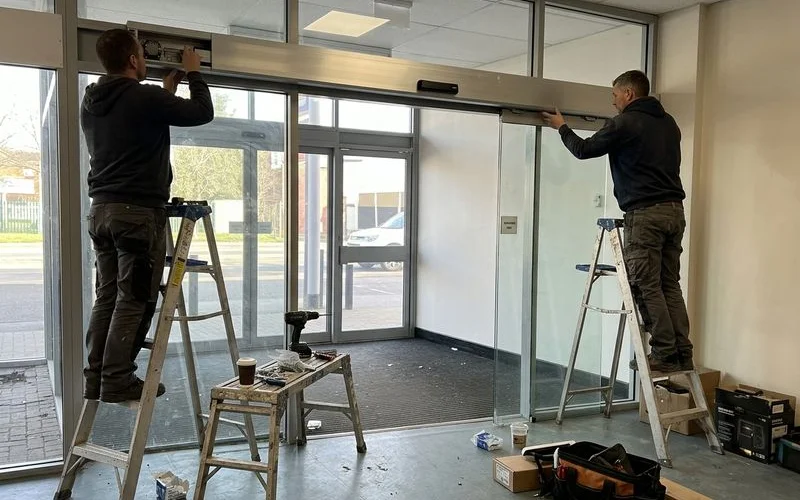
By mid-afternoon the tempered glass leaves were hanging on their roller carriages, the tooth belt was tensioned, and commissioning began: sensor sweep angles, anti-clamp force testing, backup battery cycling, and opening speeds tuned to the site’s foot traffic.
The door reopened to customers before the evening peak. Total front-entrance downtime: under eight hours.
The Result
Three months on, the numbers are what the owner cares about. Zero jams. Zero sensor complaints. And the entrance is noticeably quieter — staff at the front counter no longer hear the door at all, which is exactly what the Silent principle promises.
The site is now on a scheduled maintenance plan: twice-yearly servicing covering lubrication, belt tension, roller inspection and sensor calibration. For a door doing this volume of cycles, preventive care is what turns a good installation into a 15-year asset.
Facing the same decision on your entrance? — Explore our automatic sliding door systems